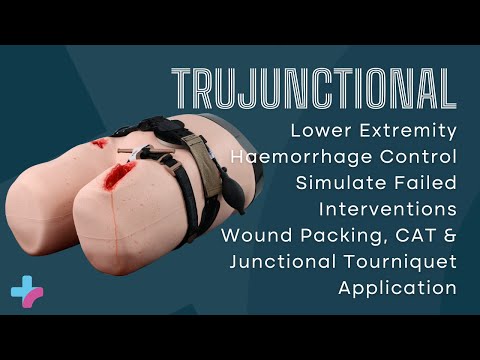
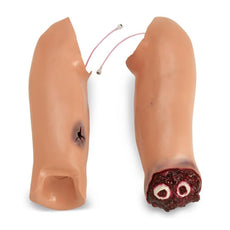
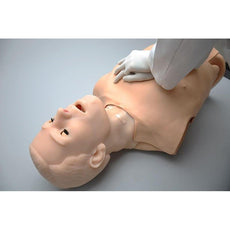
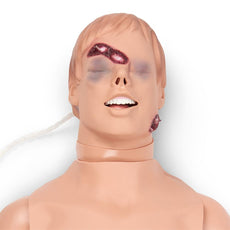
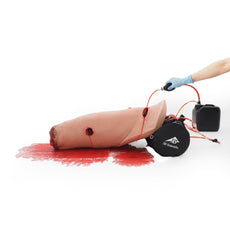
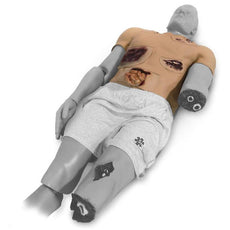
The TruJunctional is a patented trauma simulation solution engineered to replicate complex lower-body haemorrhage
scenarios with anatomical precision. The task trainer is designed with key anatomical landmarks – including the
anterior superior iliac spine, pubic symphysis, and greater trochanters—this model offers unparalleled realism for
practicing life-saving interventions in high-stakes environments.
Developed for advanced trauma training, TruJunctional supports the application of pelvic binders, CAT & junctional
tourniquets, and advanced wound management techniques for penetrating injuries such as gunshot and stab wounds. What
sets the TruJunctional apart is its ability to simulate the consequences of unsuccessful haemorrhage control. This
feature enables learners to experience the clinical implications of incorrect technique, fostering deeper
understanding, improving decision-making, and reinforcing the importance of precision under pressure.
Realistic | Clinically Accurate |
Versatile
The TruJunctional has been designed to practise massive haemorrhage control in a trauma situation. The model is
based on the lower extremity of an adult male and provides realistic bleeding control with visual feedback on user
performance.
Realistic Trauma Simulation
The patented anatomical design allows for highly accurate replication of junctional trauma. Anatomical
landmarks include:
Anterior superior iliac spine
Pubic symphysis
Greater trochanters
Trainers can activate one or both wounds independently to simulate various injury profiles, enabling both
solo and team-based scenario training.
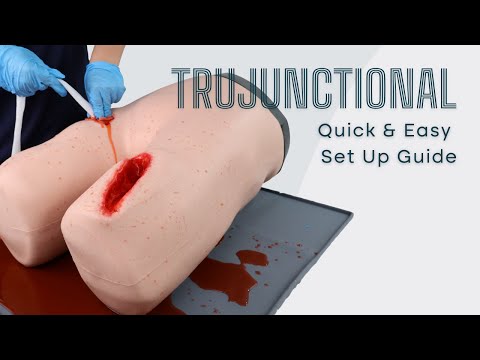
Quick and Easy Set-Up
Less than 5 mins – if the blood system is empty simply pour the blood back into the pump.
Simulated Treatment Failure
With the ability to simulate ineffective packing techniques or tourniquet application, provides valuable
exposure to real-world challenges, encouraging critical thinking and reinforcing the importance of proper
technique under pressure.
Equipment Compatibility
Supports the use of widely adopted trauma management devices such as the SAM Junctional Tourniquet, Pelvic
Binder, CAT Tourniquet, and JETT, ensuring familiarity and transferability of skills to clinical settings.
Package Contents:
x1 TruJunctional unit (TJU1000)
x1 TruJunctional carrier case
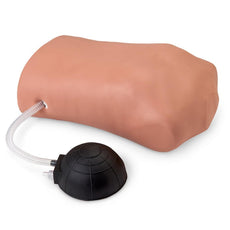
x1 Pressure pump (up to 2 litres) & tubing
x1 bottle of Concentrated blood 250ml
x1 Plastic refill funnel
x1 Silicone mat
Download:
Medical Procedure Training In:
Patient Assessment:
Pelvic Binder Application
Identification of Entry & Exit Wounds
Massive Haemorrhage Control:
Wound Packing (GSW)
CAT Tourniquet Application (Stab Wound)
Junctional Tourniquet Application
GTSimulators by Global Technologies TruCorp Authorized Dealer
Control Panel
Two dials control bleeding outcomes: the left dial sets stab wound function and the
right dial sets gunshot wound function. Each can be set to Off (no bleed),
controlled by packing/CAT®, or junctional-only, where bleeding stops only when a
junctional tourniquet is correctly applied. Enabling instructors to scale scenarios
from basic technique practice to escalation decision-making under pressure.
Hover to play
Train Simultaneously
Learners can perform wound packing and CAT tourniquet application simultaneously,
reflecting real-world haemorrhage control under time pressure. This supports
coordinated technique - maintaining effective packing while correctly positioning
and tightening the tourniquet - reinforcing prioritisation, team workflow, and
sustained control of bleeding during dynamic scenarios.
Hover to play
Pelvic Binder Application
Key anatomical landmarks - including the anterior superior iliac spine (ASIS), pubic
symphysis, and greater trochanters - are clearly defined to support accurate pelvic
binder placement and effective application.
Hover to play
Junctional Tourniquet Application
Key anatomical landmarks - including the anterior superior iliac spine (ASIS), pubic
symphysis, and greater trochanters - are clearly defined to support accurate
junctional tourniquet positioning and effective haemorrhage control, allowing
learners to position and secure the device correctly under realistic conditions.
Hover to play
Wound Packing
Realistic gunshot wound (GSW) exit wound packing with configurable haemorrhage
control outcomes. The wound can be set to allow learners to achieve haemostasis
through effective packing, or adjusted to maintain ongoing bleeding - requiring the
learner to make the appropriate escalation decision to a junctional tourniquet.
Hover to play
Identification of Entry & Exit Wounds
The trainer supports accurate identification of entry and exit wounds, enabling
learners to assess wound characteristics and prioritise haemorrhage control
interventions. By reinforcing systematic inspection and clinical decision-making, it
helps ensure appropriate treatment selection - such as targeted packing and
escalation to tourniquet strategies when required.
Hover to play
CAT Tourniquet Application
Realistic CAT tourniquet application with dynamic bleeding control feedback. Learners
can apply and secure the tourniquet to achieve effective haemorrhage control, with
the system configured to validate correct placement and tightening - reinforcing
technique, time-to-application, and escalation decision-making under pressure.
Hover to play
Set-Up in 5 Minutes
The pump system is designed for rapid, classroom-ready setup, enabling instructors to
establish controlled blood flow quickly and reset scenarios with minimal downtime.
It supports consistent, repeatable bleeding performance across multiple learners
while allowing straightforward adjustment of flow to match scenario intensity and
training objectives.
Ensure the manikin has been drained of fluids. Please store the model in clean, dry conditions
away from heat and direct sunlight. Avoid contact with metals, solvents, oils or greases and
strong detergents. When the product is not in use please store in the black carrier case
provided.
Thoroughly wash in warm water. Please use warm soapy water or similar until all visible foreign
matter and residue is removed.
Mild detergents or enzymatic cleaning agents may be used on the airway at the proper dilution.
The detergent must not contain skin or mucous membrane irritants.
In response to the recent COVID-19 pandemic, we recommend this additional step to ensure the
product is fully sanitized:
Generously spray alcohol spray or gel (minimum 75% alcohol) and wipe off. Repeat 3-4 times to
fully disinfect the product. This can be done on the silicone skin and the latex airway.
Please do not use any of the following when cleaning the TruTourniquet:
Germicides, disinfectants, or chemical agents such as glutaraldehyde (e.g. Cidex®)
Ethylene oxide, phenol-based cleaners or iodine-containing cleaners
We recommend a frequent deep clean of the internal fluid systems to prevent mould and fungal
build-up. A sterilizing product such as Milton Sterilizing Fluid is sufficient.
• Item # TJU1000
• By TruCorp — A trusted GT Partner.
• 1-Year Warranty provided by the manufacturer.
Description:
Trujunctional Advanced Trauma Training
The TruJunctional is a patented trauma simulation solution engineered to replicate complex lower-body haemorrhage
scenarios with anatomical precision. The task trainer is designed with key anatomical landmarks – including the
anterior superior iliac spine, pubic symphysis, and greater trochanters—this model offers unparalleled realism for
practicing life-saving interventions in high-stakes environments.
Developed for advanced trauma training, TruJunctional supports the application of pelvic binders, CAT & junctional
tourniquets, and advanced wound management techniques for penetrating injuries such as gunshot and stab wounds. What
sets the TruJunctional apart is its ability to simulate the consequences of unsuccessful haemorrhage control. This
feature enables learners to experience the clinical implications of incorrect technique, fostering deeper
understanding, improving decision-making, and reinforcing the importance of precision under pressure.
Realistic | Clinically Accurate |
Versatile
The TruJunctional has been designed to practise massive haemorrhage control in a trauma situation. The model is
based on the lower extremity of an adult male and provides realistic bleeding control with visual feedback on user
performance.
Realistic Trauma Simulation
The patented anatomical design allows for highly accurate replication of junctional trauma. Anatomical
landmarks include:
Anterior superior iliac spine
Pubic symphysis
Greater trochanters
Trainers can activate one or both wounds independently to simulate various injury profiles, enabling both
solo and team-based scenario training.
Quick and Easy Set-Up
Less than 5 mins – if the blood system is empty simply pour the blood back into the pump.
Simulated Treatment Failure
With the ability to simulate ineffective packing techniques or tourniquet application, provides valuable
exposure to real-world challenges, encouraging critical thinking and reinforcing the importance of proper
technique under pressure.
Equipment Compatibility
Supports the use of widely adopted trauma management devices such as the SAM Junctional Tourniquet, Pelvic
Binder, CAT Tourniquet, and JETT, ensuring familiarity and transferability of skills to clinical settings.
Package Contents:
x1 TruJunctional unit (TJU1000)
x1 TruJunctional carrier case
x1 Pressure pump (up to 2 litres) & tubing
x1 bottle of Concentrated blood 250ml
x1 Plastic refill funnel
x1 Silicone mat
Download:
Medical Procedure Training In:
Patient Assessment:
Pelvic Binder Application
Identification of Entry & Exit Wounds
Massive Haemorrhage Control:
Wound Packing (GSW)
CAT Tourniquet Application (Stab Wound)
Junctional Tourniquet Application
GTSimulators by Global Technologies TruCorp Authorized Dealer
Control Panel
Two dials control bleeding outcomes: the left dial sets stab wound function and the
right dial sets gunshot wound function. Each can be set to Off (no bleed),
controlled by packing/CAT®, or junctional-only, where bleeding stops only when a
junctional tourniquet is correctly applied. Enabling instructors to scale scenarios
from basic technique practice to escalation decision-making under pressure.
Hover to play
Train Simultaneously
Learners can perform wound packing and CAT tourniquet application simultaneously,
reflecting real-world haemorrhage control under time pressure. This supports
coordinated technique - maintaining effective packing while correctly positioning
and tightening the tourniquet - reinforcing prioritisation, team workflow, and
sustained control of bleeding during dynamic scenarios.
Hover to play
Pelvic Binder Application
Key anatomical landmarks - including the anterior superior iliac spine (ASIS), pubic
symphysis, and greater trochanters - are clearly defined to support accurate pelvic
binder placement and effective application.
Hover to play
Junctional Tourniquet Application
Key anatomical landmarks - including the anterior superior iliac spine (ASIS), pubic
symphysis, and greater trochanters - are clearly defined to support accurate
junctional tourniquet positioning and effective haemorrhage control, allowing
learners to position and secure the device correctly under realistic conditions.
Hover to play
Wound Packing
Realistic gunshot wound (GSW) exit wound packing with configurable haemorrhage
control outcomes. The wound can be set to allow learners to achieve haemostasis
through effective packing, or adjusted to maintain ongoing bleeding - requiring the
learner to make the appropriate escalation decision to a junctional tourniquet.
Hover to play
Identification of Entry & Exit Wounds
The trainer supports accurate identification of entry and exit wounds, enabling
learners to assess wound characteristics and prioritise haemorrhage control
interventions. By reinforcing systematic inspection and clinical decision-making, it
helps ensure appropriate treatment selection - such as targeted packing and
escalation to tourniquet strategies when required.
Hover to play
CAT Tourniquet Application
Realistic CAT tourniquet application with dynamic bleeding control feedback. Learners
can apply and secure the tourniquet to achieve effective haemorrhage control, with
the system configured to validate correct placement and tightening - reinforcing
technique, time-to-application, and escalation decision-making under pressure.
Hover to play
Set-Up in 5 Minutes
The pump system is designed for rapid, classroom-ready setup, enabling instructors to
establish controlled blood flow quickly and reset scenarios with minimal downtime.
It supports consistent, repeatable bleeding performance across multiple learners
while allowing straightforward adjustment of flow to match scenario intensity and
training objectives.
Ensure the manikin has been drained of fluids. Please store the model in clean, dry conditions
away from heat and direct sunlight. Avoid contact with metals, solvents, oils or greases and
strong detergents. When the product is not in use please store in the black carrier case
provided.
Thoroughly wash in warm water. Please use warm soapy water or similar until all visible foreign
matter and residue is removed.
Mild detergents or enzymatic cleaning agents may be used on the airway at the proper dilution.
The detergent must not contain skin or mucous membrane irritants.
In response to the recent COVID-19 pandemic, we recommend this additional step to ensure the
product is fully sanitized:
Generously spray alcohol spray or gel (minimum 75% alcohol) and wipe off. Repeat 3-4 times to
fully disinfect the product. This can be done on the silicone skin and the latex airway.
Please do not use any of the following when cleaning the TruTourniquet:
Germicides, disinfectants, or chemical agents such as glutaraldehyde (e.g. Cidex®)
Ethylene oxide, phenol-based cleaners or iodine-containing cleaners
We recommend a frequent deep clean of the internal fluid systems to prevent mould and fungal
build-up. A sterilizing product such as Milton Sterilizing Fluid is sufficient.